Graphite Anode Half-Cell Formation and Rate Performance Evaluation
Home » Graphite Anode Half-Cell Formation and Rate Performance Evaluation
A powerful diagnostic tool for evaluating anode utilization, formation quality,
and rate performance.
Graphite is the most common commercial lithium ion battery anode material because it offers high reversibility, low operating potential versus Li/Li+, good cycling stability, and a practical theoretical capacity of 372 mAh/g. In a half-cell configuration, graphite is paired with lithium metal so that the graphite electrode can be evaluated without cathode-side limitations. This makes the graphite half-cell a useful diagnostic platform for studying active-material utilization, formation quality, voltage profile, and rate capability.
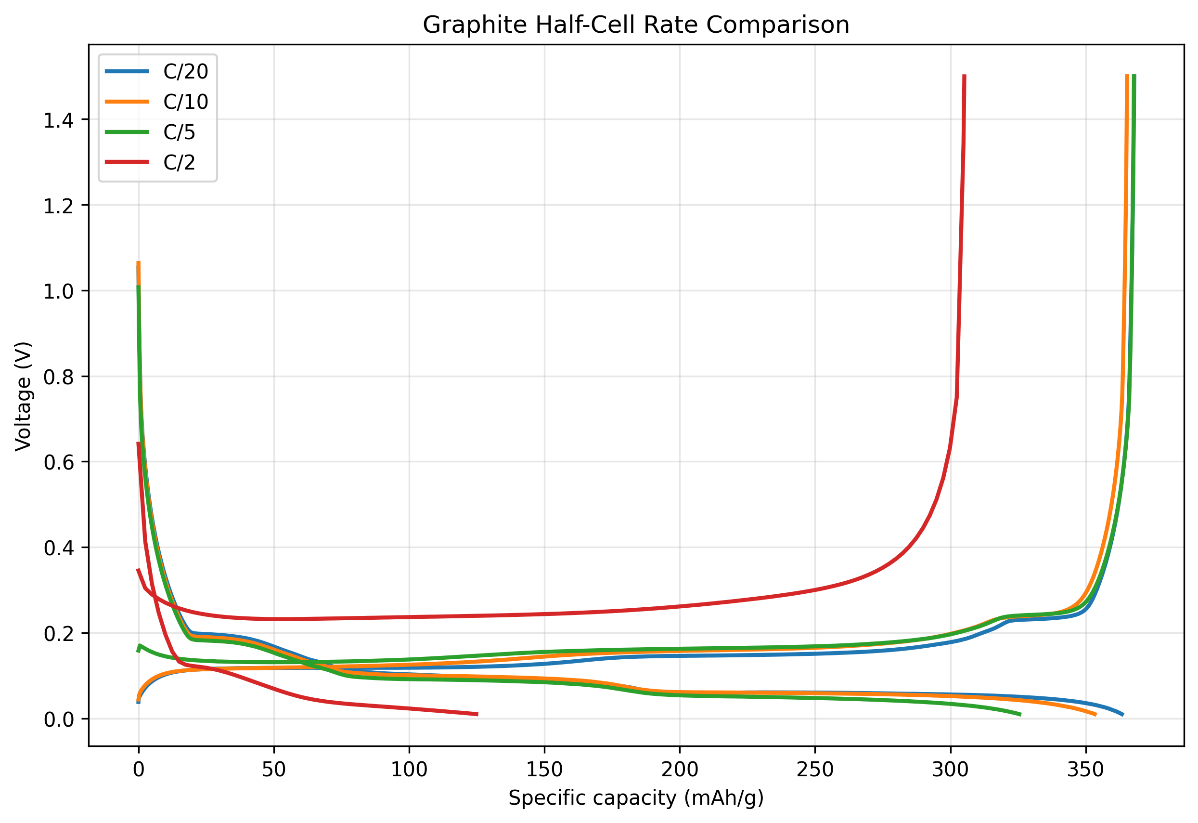
This application note describes the assembly, Neware cycling protocol, and electrochemical interpretation of graphite anode half-cells. The cells were formed at C/20 and subsequently evaluated at C/10, C/5, and C/2. The resulting voltage-specific capacity profiles are used to determine whether the measured performance is reasonable relative to the graphite theoretical capacity.
Why This Test Is Performed
Formation and rate testing are performed to answer two questions. First, the formation step evaluates whether the graphite electrode forms a stable interphase and delivers the expected graphite lithiation/delithiation profile. Second, rate testing shows how much capacity remains accessible as current increases. A strong graphite half-cell should approach the theoretical capacity at low rate and retain a significant fraction of that capacity at higher rate.
Download the application note to learn more.
Would you like to learn more about battery materials characterization?
Contact us today for your battery materials characterization needs. Please complete the form below to have an EAG expert contact you.