Gas Chromatography Quadrupole-Time of Flight Mass Spectrometry (GC/Q-TOF)
Home » Our Techniques » Mass Spectrometry » GC/Q-TOF
Instrumental Overview
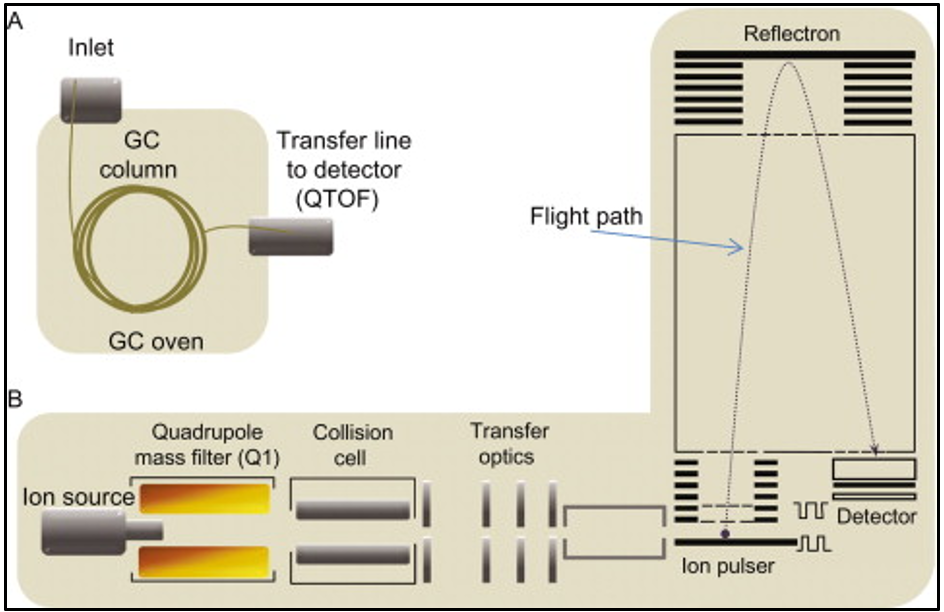
When the sample is introduced to the gas chromatograph, the sample is vaporized and separated based on the interactions between the sample analytes and the coating of the chromatographic column. After separation, the analytes enter the mass spectrometer, which has two modes of operation. The first mode of operation only utilizes the time-of-flight mass spectrometer, which provides a high-resolution screen of all analytes within the chosen mass range. This mode is most useful for improved identification of unknown analytes when compared to low resolution GC/MS analysis. The second mode of operation utilizes both the quadrupole and the time-of-flight mass analyzers. All ions, aside from the ion of interest, are filtered out in the first quadrupole, then fragmented in the collision cell. After fragmentation the ions are then analyzed in the time-of-flight mass analyzer. This mode of operation provides high resolution data of both the parent and daughter ions allowing for more confident identification of the analyte. This mode of operation is ideal for more in-depth identification of analytes that may be difficult to identify using only a standard screen. Figure 1 gives a schematic of a typical GC/Q-TOF instrument.
Sample Matrices
GC/Q-TOF, a variety of GC-MS-MS instrumentation, is capable of analyzing a wide variety of sample matrices including solid, liquid, and gas samples. A solid sample can be extracted in an appropriate solvent to analyze for semi-volatiles, or outgassed to analyze for any volatile components produced by the sold. Most liquid samples can be injected directly onto the instrument with no prior preparation required and analyzed for both volatiles and semi-volatiles. Samples that are primarily aqueous may need to be diluted or solvent exchanged prior to analysis to ensure all sample components are properly volatilized. Gas samples can also be injected directly onto the instrument and analyzed for volatile components via gas tight syringes.
Key Strengths of GC/Q-TOF
- The GC/Q-TOF is capable of more easily preserving the molecular ion of an analyte during ionization, while also providing valuable fragmentation data. This powerful combination results in more accurate identification of unknowns in a sample.
- The sensitivity of the GC/Q-TOF is significantly improved from a single quadrupole GC/MS, allowing for low level detection of unknowns during screening, which is further decreased during quantitation of target analytes.
- The GC/Q-TOF produces high resolution data in both targeted and scanning modes, which allows for identification of sample components with much higher confidence than analogous low resolution instruments.
- The large mass range that the GC/Q-TOF is able to analyze across, 20-3000 amu, also provides more confidence that any sufficiently volatile analyte will be detected.
Limitations of GC/Q-TOF
As with all gas chromatography, the GC/Q-TOF is limited to analyzing only components which are either volatile or semi-volatile.
Highly concentrated analytes are also difficult to analyze by GC/Q-TOF as detector saturation diminishes the accuracy of the mass to charge ratio significantly decreases. In the event of saturation the sample can be diluted, but this is likely to result in the loss of trace components.
Review of Ideal Use, Strengths, and Limitations of GC/Q-TOF
- Ideal Use: Only ionic analytes Volatiles analysis, Semi-volatiles analysis, Sample screening, Low-level analysis
- Strengths: Superior fragmentation, Very broad mass range, High resolution data, Low level screening, Low level targeted analysis
- Limitations: Analytes must be volatile or semi-volatile, Highly concentrated samples cause decrease in mass accuracy
GC/Q-TOF Technical Specifications
- Mode of Ionizations: Electron Ionization, Low Energy Electron Ionization
- Mass Range: 20-3000 amu
- Mass Analyzer 1: Quadrupole
- Collision Cell: Hexapole
- Mass Analyzer 2: Time-of-Flight
- Detector: Photomultiplier Tube
*Gushue, J. N. (2013). Principles and Applications of Gas Chromatography Quadrupole Time-of-Flight Mass Spectrometry. In Comprehensive Analytical Chemistry (Vol. 61, pp. 255-270). Elsevier.
Would you like to learn more about GC/Q-TOF?
Contact us today for your GC/Q-TOF needs. Please complete the form below to have an EAG expert contact you.