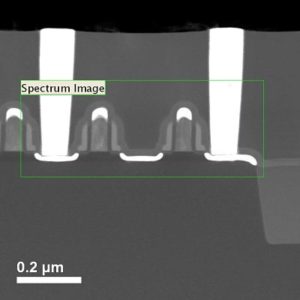
Two-dimensional Mapping of Matrix Elements in a Microelectronic Device by STEM-EELS
Two-dimensional mapping of matrix elements in electronic devices is discussed, as provided by STEM and EELS techniques from EAG Laboratories.

Home » International Materials Applications & Technologies (IMAT)
Dr. Rajiv Soman, EAG Laboratories presented “Advances in Characterization and Certification of Additively Manufactured Alloys and Their Feed Materials.”
Additive manufacturing (3D printing) technology has improved significantly over the last few years and now is routinely being applied for the manufacture of a wide range of advanced materials. Metal alloys, and in-service parts can now be printed from a fine powder mix (feed material) that is fused by a laser, building up the product layer by layer.
Dr. Rajiv Soman, EAG Laboratories presented “Advances in Characterization and Certification of Additively Manufactured Alloys and Their Feed Materials.”
Additive manufacturing (3D printing) technology has improved significantly over the last few years and now is routinely being applied for the manufacture of a wide range of advanced materials. Metal alloys, and in-service parts can now be printed from a fine powder mix (feed material) that is fused by a laser, building up the product layer by layer. Metal alloys fused together in this process may produce products with slightly different mechanical and chemical characteristics than products produced by casting the alloys with a similar chemical composition. Many of these printed metal products are being used in aerospace and medical applications where product quality is critical.
The chemical characteristics of the feed materials and the metal alloys are typically evaluated using analytical techniques such as ICP, Glow Discharge Mass Spectrometry (GD-MS), Laser Induced Breakdown Spectroscopy (LIBS), XRF, IGA and Residual Gas Analysis (RGA). Comparative analytical techniques require calibration and verification with certified reference materials. While certified reference materials exist for many cast alloy grades, there currently are limited reference materials for additively manufactured powders, or the alloys produced by this process
We present new, certified reference materials of additive manufacturing powders for three commonly printed alloy grades; Ti-6Al-4V, 316L type stainless steel, and Inconel 718, and include our findings from chemical characterization studies. These alloy types have wide-spread applications in aerospace, and in medical device industry. In addition, we present reference materials for the alloys printed from these powders to alloy quality control at the pre-printing and posting printing stage to monitor any variation induced by the printing process. The Certified Reference Materials (CRMs) have been produced using in an ISO 17034 accredited process, and chemical analysis has been conducted in ISO/IEC 17025:2017, ISO 9001:2015, and NadCap accredited, materials characterization laboratory.

Two-dimensional mapping of matrix elements in electronic devices is discussed, as provided by STEM and EELS techniques from EAG Laboratories.
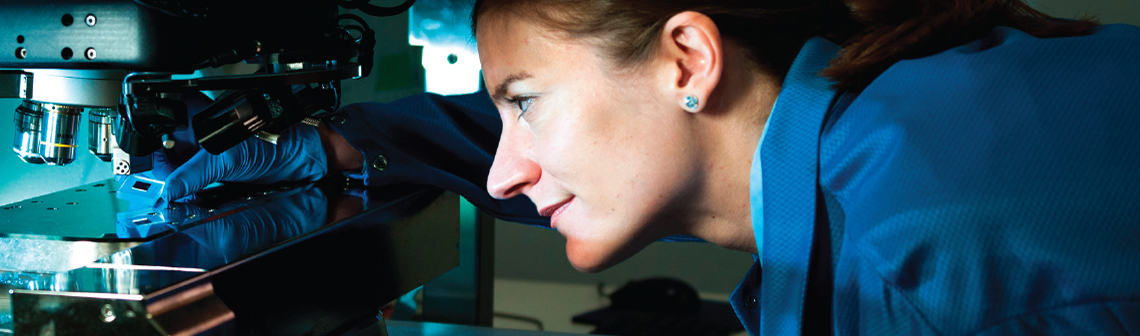
EAG can provide high-resolution imaging and help you perform structural analysis, research and development
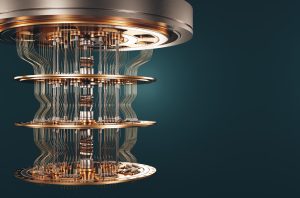
Quantum computing has the potential to revolutionize various fields by solving problems that are currently intractable for classical computers.
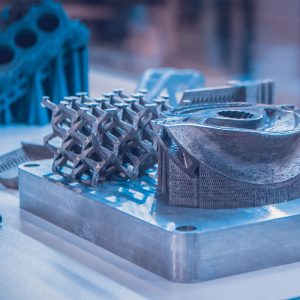
For 3D printed products, XPS can provide composition and bonding information for the top 5-10nm sample surfaces. Oftentimes, surface contamination/oxide thickness would affect the appearance (as well as performance when applicable) of the material, and XPS could help identify the source and/or cause.
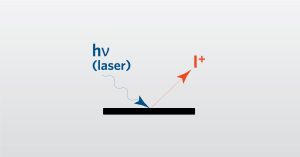
This webinar is an introduction to Laser Ablation-Inductively Coupled Plasma-Mass Spectrometry for direct elemental and isotopic analysis.

Blisters were observed in paint applied to steel plates that had undergone treatment with a corrosion inhibitor. An investigation was performed to determine if there was evidence of contamination on the inside of the blister.
To enable certain features and improve your experience with us, this site stores cookies on your computer. Please click Continue to provide your authorization and permanently remove this message.
To find out more, please see our privacy policy.