Four-Point Probe
Home » Our Techniques » Four-Point Probe
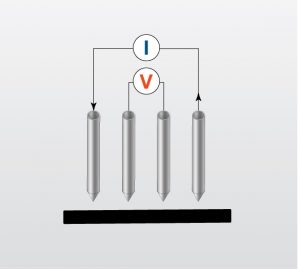
A four-point probe is an electrical measurement technique and device used to determine the sheet resistance (Rs) and bulk resistivity (ρ) of conductive or semiconducting materials without the error caused by lead and contact resistance.
The system uses four equally spaced (s), sharp metal pins aligned in a straight line to apply a controlled DC current (I) through the two outer probes (probes 1 and 4). A high-impedance voltmeter measures the resulting voltage drop (V) across the two inner probes (probes 2 and 3). Once the system captures the exact current (I) and the exact voltage (V), it computes the resistance (R = V/I). It then applies geometric correction factors based on how thick or wide the sample is to output the final sheet resistance or bulk resistivity.
Ideal Uses of Four-Point Probe
- Semiconductor & Microelectronics
- Solar & Photovoltaics
- Thin Films & Advanced Coatings
- Energy Storage & Displays
Strengths
- Eliminates Lead and Contact Resistance: This is the primary advantage
- Highly Accurate for Low-Resistivity Materials
- Simple Sample Preparation
- Nondestructive
- Robust Mathematical Framework
Limitations
- Sample Thickness Sensitivity
- Surface Piercing and Damage
- Requires Ohmic (Good) Contacts
- Edge Effects
- Cannot Map Lateral Anisotropy Well
Technical Specifications
- Sheet Resistance Range: 100 mΩ/sq – 10 MΩ/sq
- Sample size range: 5mm X 152mm
- Maximum Sample Thickness: 8mm (soft-tip); 6mm (sharp-tip)
Would you like to learn more about Four-Point Probe analysis?
Contact us today for your Four-Point Probe analysis needs. Please complete the form below to have an EAG expert contact you.