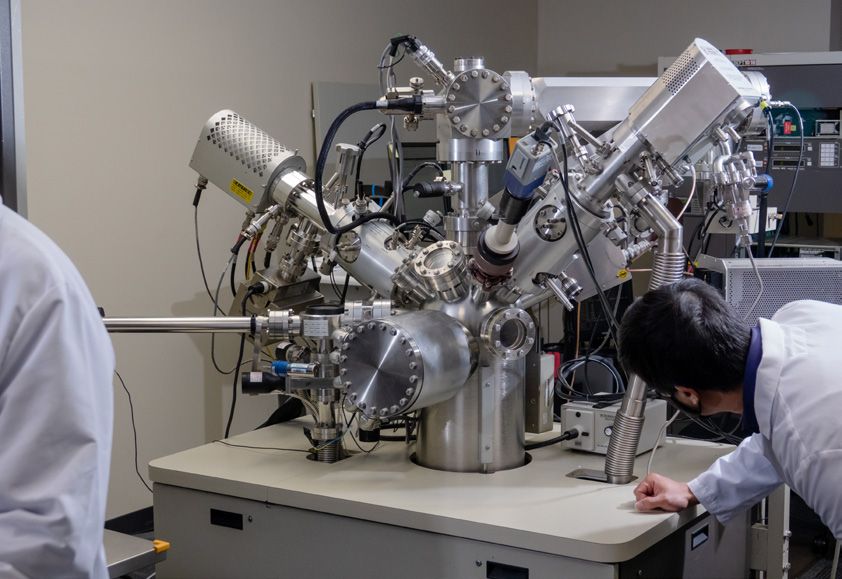
Dual Beam FIB-SEM: Sample prepping and Imaging
The Dual Beam FIB-SEM integrates a focused ion beam with a scanning electron microscope for simultaneous sample prepping and imaging.
Home » When SIMS Becomes Essential: A Practical Guide
In advanced materials characterization, there are many analytical tools available, each with their own strengths. Techniques like XPS, EDS, AES, GDMS, ICP-MS, and FTIR all play important roles in understanding composition, contamination, interfaces, and thin films. But there are moments when conventional techniques simply cannot provide the answer that engineers and scientists need.
That is when Secondary Ion Mass Spectrometry (SIMS) becomes indispensable.
For applications involving ultra-trace detection, nanometer-scale depth profiling, buried interfaces, or complex contamination mechanisms, SIMS is often the only technique capable of delivering the required sensitivity and resolution simultaneously.
This is why SIMS continues to be one of the most critical analytical methods across semiconductors, aerospace, defense, advanced materials, batteries, photonics, and emerging electronics.
SIMS fills the gap when engineers need:
SIMS can provide elemental depth profiles spanning from a few angstroms to tens of micrometers while detecting extremely low concentrations of dopants and impurities.
Dynamic SIMS is often the preferred method when precise elemental depth profiling is required.
In this approach, the surface is continuously sputtered with a primary ion beam while secondary ions are analyzed in real time. The result is a highly sensitive concentration-versus-depth profile that reveals how elements are distributed throughout thin films, coatings, semiconductor structures, or multilayer devices.
This capability becomes critical for applications such as:
Dynamic SIMS supports ultra-high depth resolution and high-precision matching of semiconductor process tools. Check out our Dynamic SIMS techniques page.
For modern semiconductor devices, where layers may only be a few nanometers thick, that level of resolution is essential.
While Dynamic SIMS excels at quantitative depth profiling, Time-of-Flight SIMS (TOF-SIMS) provides another critical advantage: molecular and surface-level analysis.
TOF-SIMS can identify both elemental and molecular species directly from the uppermost atomic layers of a surface. This makes it exceptionally valuable for:
Our TOF-SIMS techniques page highlights the method’s ability to provide elemental and molecular information from micron-scale defects and particles while also supporting imaging and depth profiling capabilities.
This is especially important when investigating contamination events where traditional methods cannot determine the root chemical source.
For example, a particle detected through SEM may reveal morphology, but not the molecular species responsible for device failure. TOF-SIMS can often identify whether the contamination originated from pump oil, process residue, packaging materials, handling contamination, or outgassing compounds.
Modern semiconductor devices continue to shrink while becoming increasingly complex. As feature sizes decrease, contamination thresholds also decrease. A trace impurity that was once irrelevant can now produce device yield, impact reliability, or create catastrophic failures.
SIMS is uniquely positioned to address these challenges because it can:
In many advanced semiconductor workflows, SIMS is the only viable analytical path.
The importance of SIMS is rapidly growing in advanced battery research and emerging materials systems.
Battery researchers increasingly rely on TOF-SIMS to investigate:
TOF-SIMS combines extremely high sensitivity with the ability to analyze organic, inorganic, and hybrid materials across thin films, powders, and interfaces.
Similarly, advanced photonics, quantum materials, aerospace coatings, and rare earth materials all present characterization challenges where conventional methods struggle to provide adequate depth or sensitivity.
SIMS bridges that gap.
One of the biggest misconceptions about SIMS Is that it is simply just another surface analysis method. It is not. SIMS occupies a unique position because it combines:
Very few analytical methods can achieve all of these simultaneously.
That is why SIMS frequently becomes the technique of last resort, not because it failed earlier in the workflow, but because it is the only method capable of answering the question.
As technologies continue moving toward smaller geometries, thinner films, cleaner processes, and more complex interfaces, the analytical challenges facing engineers and scientists will only intensify.
When the problem involves ultra-trace contamination, buried interfaces, nanoscale depth profiling, or molecular surface chemistry, conventional techniques often reach their limits. SIMS does not.

The Dual Beam FIB-SEM integrates a focused ion beam with a scanning electron microscope for simultaneous sample prepping and imaging.

October 23
During this live Ask the Expert event, we will answer pre-submitted questions from our audience regarding brazing.

In this webinar we will focus on Energy Dispersive X-ray Spectroscopy (EDS) and Scanning Electron Microscopy (SEM)

In this webinar we introduce Metal Based Additive Manufacturing Analysis to understand and evaluate many aspects of the metallurgy.
To enable certain features and improve your experience with us, this site stores cookies on your computer. Please click Continue to provide your authorization and permanently remove this message.
To find out more, please see our privacy policy.