Consumer Product Biocompatibility Testing Webinar
Wednesday, May 14, 2025
This webinar will cover the chemical characterization of consumer products using extractable/leachable studies. Register to reserve your spot today!
Home » GC-MS Analysis on 3D Printed Titanium
Additive manufacturing (AM), also known as 3D printing, is transforming how products and parts are manufactured. It enables the creation and freedom of design for a variety of products from personal items such as keychains to customized consumer products in medical, aerospace, automotive industries and more. The product quality requirements in these high-tech sectors have validated the need for advanced materials characterization.
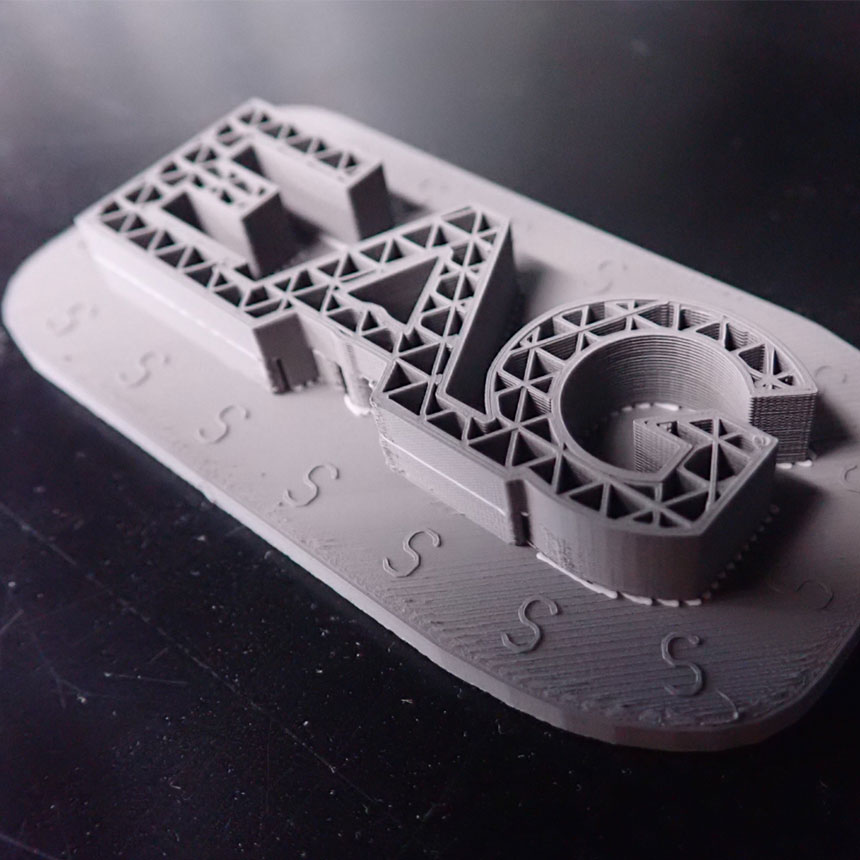
In this example, we noticed contamination on a 3D printed titanium sample. The contamination appeared to be a silicon-based oil/grease contamination which may have occurred during the printing process. We decided to use Gas Chromatography Mass Spectrometry (GC-MS) as it is a technique that can detect and identify the volatile compounds present in most oils, greases and silicones.
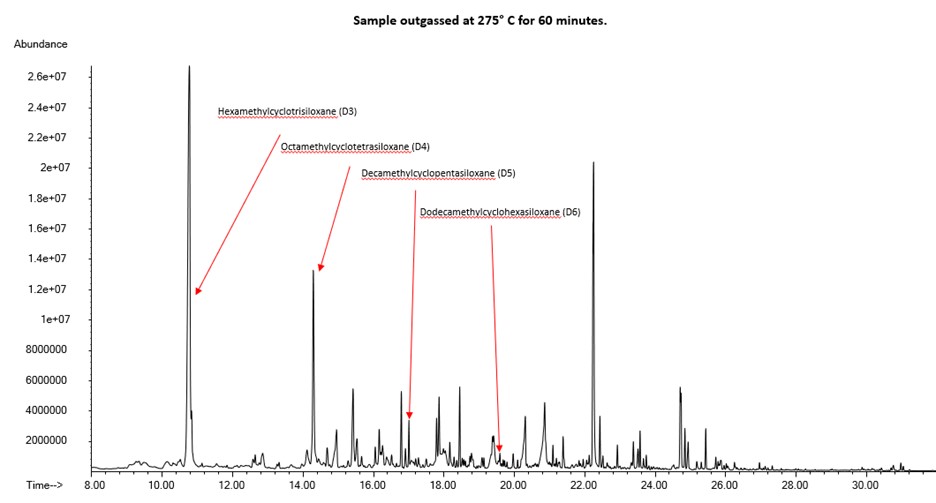
Outgassing GC-MS can detect volatile organic compounds (VOCs) such as solvents, adhesives/epoxies, monomers, and oils at a ppb detection limit. The 3D cast titanium sample was outgassed at 275 C for 60 minutes with the cryotrap temperature held at -70 C. The data shows peaks correlating to common cyclic siloxane species present on the 3D printed part. This data agreed with previous technique
assessments that silicone species were present, but goes a step further by identifying the exact silicone species.
GC-MS can help with failure analysis or contamination characterization analysis on 3D printed parts. Utilizing a variety of different sampling techniques, GC-MS is a versatile tool that can identify specific species of volatile organic compounds. GC-MS can reveal not just classifications of molecules, but the exact molecules present in an analysis. This technique is innately semi-quantitative, but can be quantitative by using multi-point calibration curves for species of interest.
At Eurofins EAG, our technical experts have many years of experience working with our clients to help solve contamination and failure-related problems. Contact us today to learn how we can help you on your next 3D printed project.

Wednesday, May 14, 2025
This webinar will cover the chemical characterization of consumer products using extractable/leachable studies. Register to reserve your spot today!

Minerology was one of the earliest fields to benefit from X-ray Diffraction (XRD). Prior to XRD, minerals could only be identified by their external symmetry, shape, and color. XRD transformed mineral identification into an exact science, being perfect for characterizing crystalline materials by their internal structure, not just external appearance.

Gallium oxide has the potential to replace or substitute gallium nitride for power conversion in electric trains and vehicles.

Knowing the type of stress and how much there is in a small metal component in a medical device can be the determining factor on how well the device will perform, how long the device will last, or even whether or not the device is going to work at all.
To enable certain features and improve your experience with us, this site stores cookies on your computer. Please click Continue to provide your authorization and permanently remove this message.
To find out more, please see our privacy policy.