Grain Refinement and Performance Gains with AI-Sc Systems

Aluminum is famous in its place in aerospace hangars, automotive plants, and advanced manufacturing labs for a reason. It’s lightweight, corrosion resistant, and strong for its weight. For decades, that combination has made it indispensable.  

But engineering never stands still. 

Aircrafts are expected to fly farther. Vehicles are expected to go lighter and safer. Additive manufacturing is publishing geometry beyond what conventional forming ever allowed. And with those expectations comes a simple question: How do we get more performance out of aluminum without adding weight?  

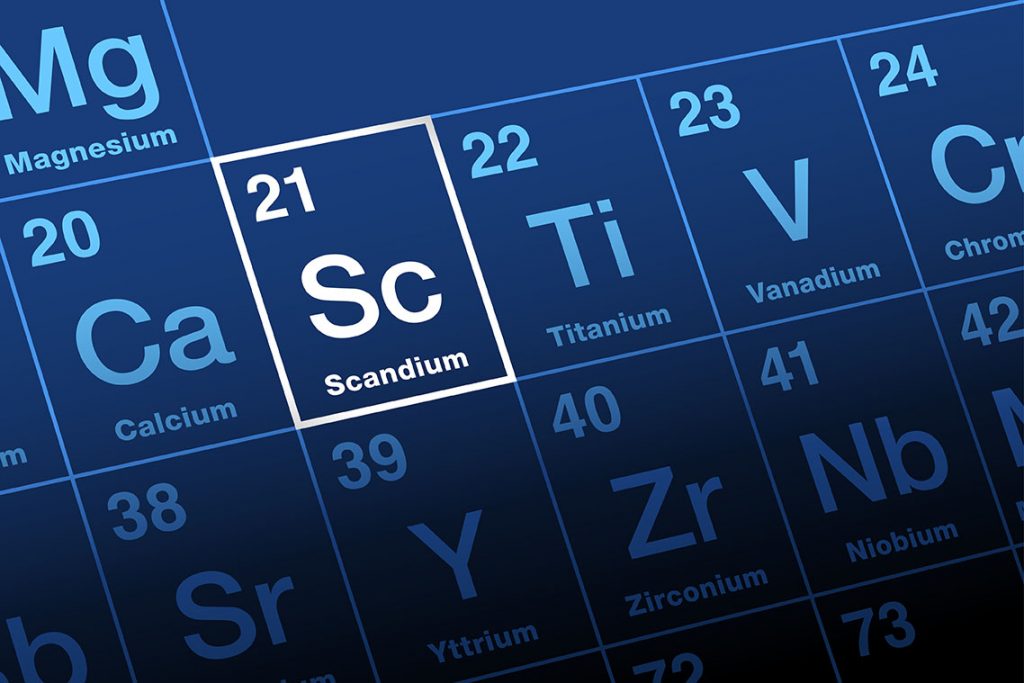
The answer lies in something surprisingly small: scandium. 

A Small Addition That Changes the Structure

Less than 1 wt% scandium can drastically refine the grain structure of aluminum. That grain structure is where the story begins. 

Finer grains mean higher strengthimproved resistance to recrystallization, and better fatigue performance. It also improves weldability, a major advantage in both traditional fabrication and additive manufacturing. Aluminum and scandium already among the highest in specific strength individually. Together, they produce alloys that maintain aluminum’s lightweight nature while delivering meaningful mechanical gains. 

In performance-driven industries, incremental improvements compound quickly. A small compositional shift can unlock entirely new design margins. 

Aerospace and Defense

In aerospace and defense, materials don’t get second chances. They operate under cyclic loading, vibration, temperature swings, and long service lifetimes.

Aluminum-magnesium alloys are already common in structural components. Introducing scandium alloys strengthens that foundation. Engineers see improvements in:

  • Specific strength

  • Thermal stability

  • Resistance to fatigue and crack growth

  • Microstructural stability during processing

This results in lighter structural components such as bulkheads and support structures without sacrificing reliability. Reduced weight directly translates to improved fuel efficiency, increased payload flexibility, and longer service intervals. 

When margins matter, grain structures matter.

Additive Manufacturing: Stability from Powder to Part

Additive manufacturing introduces its own challenges. Rapid heating and cooling cycles can lead to cracking, distortion, or inconsistent microstructures. 

Scandium helps stabilize the process. 

Improved weldability reduces hot cracking. Refined grains improve structural consistency layer by layer. This allows engineers to design more complex geometries, consolidate parts, and reduce the need for fasteners and multi-piece assemblies. 

But chemistry becomes even more critical in this space. 

In powder-based additive systems, particle size distribution, density, and impurity levels directly influence packing behavior, melt stability, and final mechanical performance. Even trace elements, particularly oxygen, can have outsized effects. 

When you’re building components layer by layer, every variable counts. 

Automotive: Balancing Strength and Efficiency

The automotive industry faces a different, but equally demanding challenge: reduce weight while preserving safety. 

AI-Sc alloys offer a compelling balance of strength and ductility. Lighter structural frames improve fuel efficiency and range, especially in electric vehicles, while maintaining crash performance standards. 

As efficiency targets rise and emissions regulations tighten, materials innovation becomes a central strategy, not just a supporting role. 

Why Characterization Matters

With higher-performance alloys comes a higher need for precision. 

Understanding both major constituents and trace-level impurities is essential for predictable mechanical behavior. Techniques such as  

  • Inductively Coupled Plasma Optical Emission Spectroscopy (ICP-OES) 
  • Inductively Coupled Plasma Mass Spectrometry (ICP-MS) 
  • Glow Discharge Mass Spectrometry (GDMS) 
  • Instrumental Gas Analysis (IGA, often referred to as LECO analysis) 
  • and Particle Size Distribution (PSD) and Density Analysis 
     

Provide detailed insight into elemental composition, from primary alloying elements to ppm-level contaminants. 

In addictive manufacturing, especially monitoring hydrogen, oxygen, carbon, nitrogen, and sulfur is critical. Powder characteristics, including particle size and distribution and density, influence packing and weld behavior, ultimately affecting structural integrity. 

When less than 1% of an element can significantly alter performance, analytical certainty becomes non-negotiable. 

For manufacturers, these data support: 

  • Supplier Qualification 
  • Failure Analysis 
  • Process Optimization 
  • Regulatory and Customer Compliance 
  • R&D Validation 

At Eurofins EAG Laboratories, each alloy system is evaluated in the context of its application. That collaborative approach allows analytical data to support real engineering decisions. 

Looking Ahead

Aluminum-scandium systems reflect a broader shift in how engineers think about performance.

As aerospace, defense, automotive, and additive manufacturing industries continue to demand more from their materials, AI-Sc alloys offer a practical path forward, grounded in microstructural control and chemical precision.

Comprehensive analytical characterization is one of the most important steps in ensuring performance translates from theory to application. Contact an expert today to discuss how EAG can support your AI-Sc development and qualification needs.

The biggest gains start at the smallest scale.

More content you might like...

To enable certain features and improve your experience with us, this site stores cookies on your computer. Please click Continue to provide your authorization and permanently remove this message.

To find out more, please see our privacy policy.