
Understanding Flame Atomic Absorption Spectroscopy (FAAS)

Flame Atomic Absorption Spectroscopy (FAAS) continues to play an important role in routine elemental analysis, even as laboratories have widely adopted Inductively Coupled Plasma-based instruments. While techniques such as ICP-OES and ICP-MS offer simultaneous multi-element analysis, enhanced sensitivity, and a wider dynamic measurement range than FAAS, they are not always the best choice for every application. 

At Eurofins EAG Laboratories, FAAS is used when it best aligns with a client’s analytical goals, regulatory requirements, and sample matrix. In many cases, a robust, cost efficient, single-analyte-at-a-time technique like FAAS delivers accurate results faster and with far rarer spectral interferences than ICP techniques. Our technical experts are available to consult with you, review your analytical needs, and help determine the most appropriate technique to ensure reliable, actionable results. 

How FAAS Works

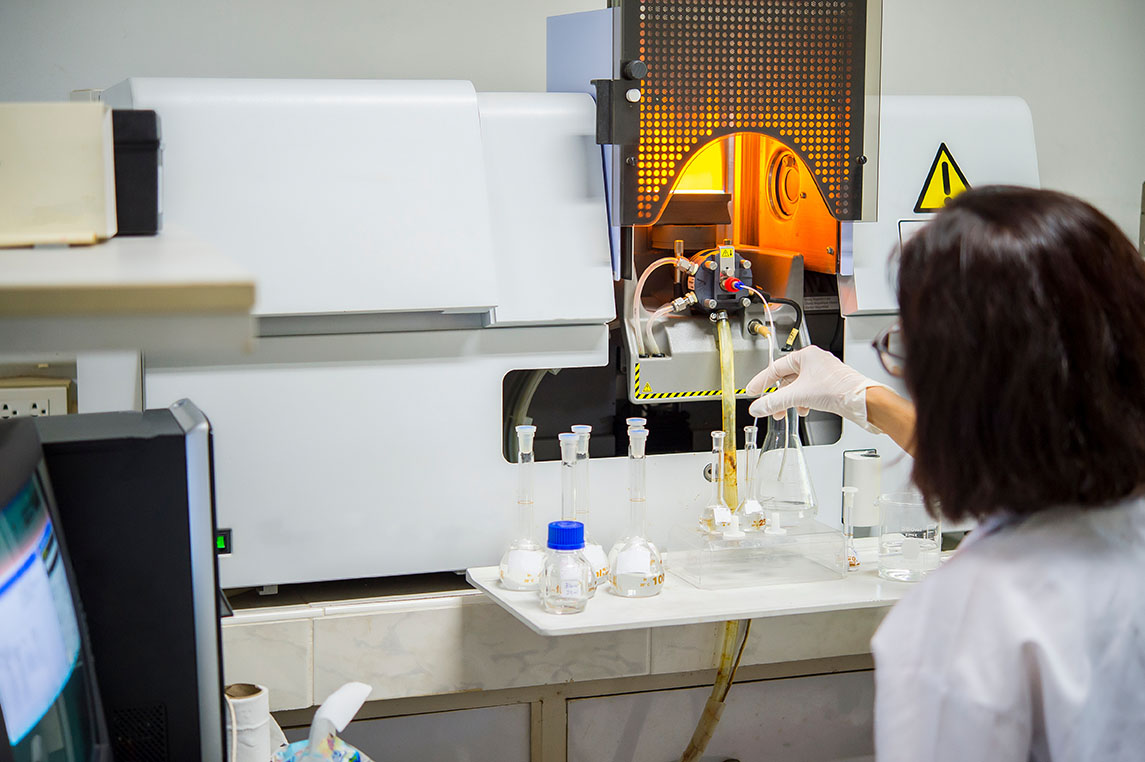
FAAS measures elemental concentration by monitoring how much light is absorbed by free atoms in a flame. A sample is atomized using an air-acetylene or nitrous oxide flame, while an element-specific hollow cathode lamp emits light at a precise wavelength. The amount of absorbed light is directly related to concentration, allowing for reliable quantification using Beer’s Law. 

Because FAAS targets one element at a time, it offers high selectivity and straightforward data interpretation. 

When FAAS Is the Right Choice

FAAS is most effective for applications with concise analyte lists and moderate sensitivity requirements. It is often selected for routine, high-volume testing where speed, reliability, and regulatory alignment matter. FAAS is a good fit when: 

  • Only one or two elements are required per sample 
  • Moderate detection limits meet regulatory or process needs 
  • Simple method development and validation are preferred 
  • High dissolved solids or salts may complicate plasma-based techniques 
  • Narrow, element-specific absorption lines reduce spectral interference 
  • Fast turnaround and high sample throughput are needed 
  • Industry or regulatory standard methods explicitly specify AAS 

Strengths of FAAS

FAAS offers several practical advantages that continue to make it a valuable technique in commercial analytical libraries: 

  • Rare and mitigable interferences due to element-specific light sources 
  • Reliable performance for routine and repeatable measurements 
  • Straightforward data processing and interpretation  
  • Lower operating and maintenance costs compared to plasma-based systems 
  • Stable operation for samples with challenging or complex matrixes  
  • Well-established and widely accepted methodology across industries 

Limitations of Atomic Absorption Spectroscopy

  • Single Element Analysis: AAS typically measures one element at a time, which can be time-consuming for multi-element analysis. 
  • Sample Preparation: Sometimes complex sample preparation is required for analysis, which can be laborious. 
  • Interference: Matrix effects or spectral interferences from other elements can affect accuracy. 
  • Limited to Specific Elements: AAS might not be suitable for some elements that don’t have strong absorption lines in the visible or UV range. 

Technical Specifications

  • Signal Detected: Photons (absorbed)
  • Sample Size Requirement: 250 mg to 1 gram of solid sample; typical solution sample volumes range from 2 to 10 mL
  • Range of Elements Detected: Aluminum, Antimony, Arsenic, Cadmium, Calcium, Cobalt, Chromium, Copper, Gold, Iron, Lead, Magnesium, Manganese, Mercury, Nickel, Potassium, Selenium, Silicon, Sodium, and Zinc
  • Typical Detection Limits: (solid sample for digestion), (liquid sample)
  • Depth Resolution: None; bulk sampling analysis technique
  • Spatially Resolved Analysis: No
  • Imaging/Mapping: No

Applications

FAAS is widely used for environmental testing of water and soils, quality control in foods, pharmaceutical, and personal care products, and industrial manufacturing, metallurgical and plating bath analysis, and digested geological or mining samples. 

Why FAAS Still Matters

Despite advances in multi-element instrumentation, FAAS remains a practical and dependable tool in modern analytical laboratories. Its value lies in its efficiency, selectivity, and consistency when the application calls for targeted element measurement. 

At Eurofins EAG Laboratories, we offer both FAAS and ICP-OES and select the technique that best fits each project’s technical and regulatory requirements. When the analyte list is focused and the goals are clearly defined, FAAS often provides the most efficient path to high-quality data. Consult an expert today. 

More content you might like...

XRF & TXRF

XRF Webinar

In this webinar we introduce X-ray Fluorescence Spectroscopy (XRF) which is a analytical technique used for elemental analysis of materials.

Read More »

To enable certain features and improve your experience with us, this site stores cookies on your computer. Please click Continue to provide your authorization and permanently remove this message.

To find out more, please see our privacy policy.