International Conference on Aluminum Alloys (ICAA 20)

September 15-16, 2026

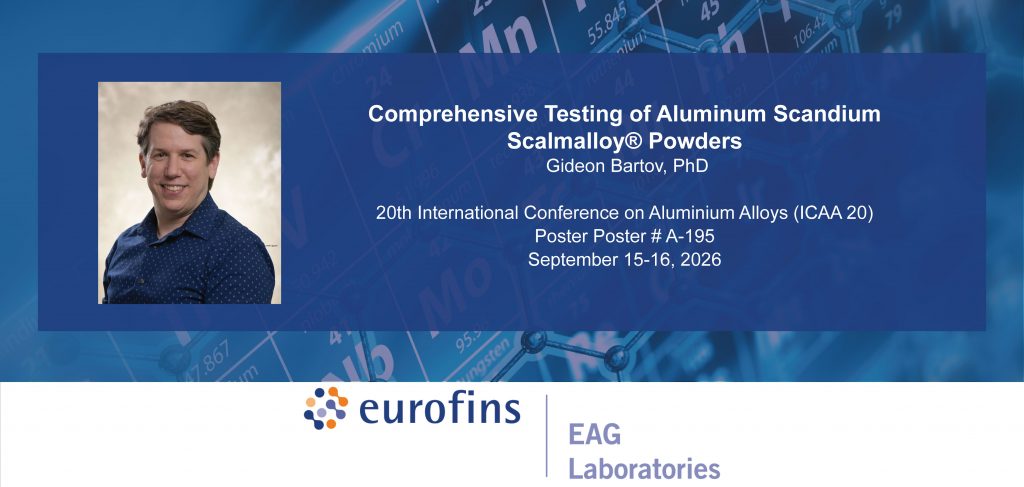
We are excited to announce that Eurofins EAG Laboratories will be speaking at ICAA 20 in Berlin, Germany, on September 15-16, 2026.


Poster: Comprehensive Testing of Aluminum Scandium Scalmalloy® Powders. 
Program Number: A-195
Session Date: September 15 – September 16, 2026
Session Time: 13:10 – 14:30 CEST (1:10 – 2:30 PM CEST)

Comprehensive Testing of Aluminum Scandium Scalmalloy® Powder

Aluminum (Al) alloys have long been favored in many industries due to their low density, high specific strength, and corrosion resistance. However, as the push for lighter and stronger materials continues, aluminum scandium (AlSc) alloys have emerged as powerful candidates to become the next generation alloys. Adding less than 1 wt% of scandium (Sc) to an Al alloy refines the grain structure and increases the specific strength and improves weld performance. Aluminum and scandium have the second and fourth highest specific strengths of all metals, respectively. That means it is possible to achieve similar physical behaviors as other aluminum alloys, but at a lower density, which in turn will reduce the overall weight of the alloy.

One of the main aluminum alloy types to benefit from Sc addition is the aluminum magnesium (AlMg) alloy 5000 series. Adding Sc to AlMg alloys improves their specific strength, formability, thermal stability, resistance to recrystallization, and resistance against fatigue crack growth.

Scalmalloy® is an AlMg alloy with Sc added to the base alloy. It is produced as 20–63μm particles intended for additive manufacturing (AM). AM is a manufacturing technique that enables producing lighter, more complex parts. However, one of the challenges facing AM using AlSc alloys is the oxygen content within the alloy. Sc readily oxidizes; therefore, knowing the oxygen level in the alloy is imperative since it will affect the alloy’s ability to weld to itself.

EAG Laboratories has over 30 years experience conducting comprehensive testing on pure metals, metal alloys and ceramics. Using a combination of glow discharge mass spectrometry (GDMS), Inductively-coupled plasma optical emission spectroscopy (ICP-OES), instrumental gas analysis (IGA), particle size distribution (PSD) analysis, and density measurements we are able to perform a comprehensive analysis of Scalmalloy®, ensuring the material is within required specifications – as well as provide invaluable information regarding the trace element composition – to ensure proper performance of manufactured materials, where failure is not an option.

More content you might like...

TEM

To enable certain features and improve your experience with us, this site stores cookies on your computer. Please click Continue to provide your authorization and permanently remove this message.

To find out more, please see our privacy policy.