EAG Discovery Lunch, Syracuse
Join us for an engaging in-person event at our Syracuse/Liverpool, NY lab.
Home » Advanced Sample Preparation for Radiation Effects Testing
Space presents one of the harshest environments for electronic components and packages, where they must endure intense and unpredictable dose, intensity, and exposure from natural radiation sources such as Solar Particle Events (SPE), Galactic Cosmic Rays (GCR), and Trapped Particles (TP). These high‑energy particles can disrupt internal circuits, degrade performance, threaten long‑term reliability, or cause catastrophic failures, challenges that are especially critical for satellites, deep‑space missions, and high‑altitude aviation systems.
To mitigate and prevent these issues, researchers developed Radiation Effects Testing, a process where electronic components undergo controlled simulation in specialized facilities to assess and evaluate its effects when exposed to harsh space environments. Out of the various testing methods, the two most utilized are:
These simulations can help identify vulnerabilities, validate design robustness, and ensure mission‑critical performance, allowing electronics to withstand the harsh conditions of space.
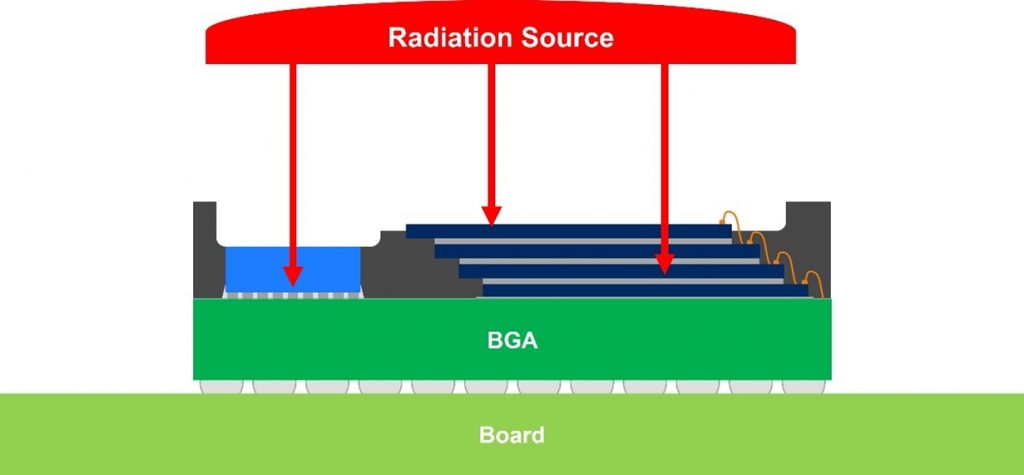
Traditionally, aerospace industries have relied on expensive hermetically sealed space-grade package types for their robust shielding and durability withstanding the harsh space radiation environments. As demand for space missions continues to grow, the aerospace industry is switching to commercial off-the-shelf (COTS) components as a cost-effective alternative. Commercial grade components are generally encapsulated by a molding compound mixture. Most facilities don’t have strong enough radiation sources to be able to test through this outer molding compound layer.
To overcome these challenges, sample preparation techniques are conducted to selectively remove layers of material that may reduce the effects of radiation testing. Removing non-functional layers of the package/assembly will effectively make the devices of interest more susceptible to an equivalent dose of radiation. This can enable testing on encapsulated samples, dramatically reduce beam time, reduce facility costs, and improve the testing accuracy/repeatability.
Sample preparation methods vary depending on the package type, complexity, and end application. These methods are carefully selected to safely and efficiently remove encapsulants, while also preserving their overall electrical functionality and packaging integrity.
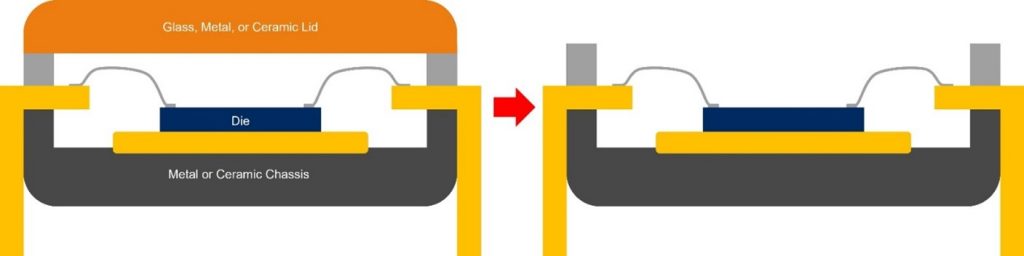
For space-grade and/or hermetically sealed packages, which typically use glass, ceramic, or metal lids, de-lidding is generally performed mechanically with precision grinding, cutting tools, or by applying controlled heat.
For plastic-encapsulated packages, decapsulation is performed using laser ablation, wet chemical etching, dry plasma etching, or a combination of these techniques.
For complex packages such as flip-chip devices, backside access is often required, Backside Die Thinning is performed using controlled grinding or chemical-mechanical polishing to reduce silicon thickness. This capability is critical for backside particle penetration during SEE testing, minimizing substrate doping and shielding, enabling other advanced diagnostics such as Laser Pulse/Injection Testing, Failure Analysis, or FIB techniques. See Precise Backside Die-Thinning for extended die-thinning capabilities.
EAG has broad and practical Failure Analysis expertise in advanced technology part types, and an established, expanding relationship with customers in the aerospace and defense industries, allowing extensive exposure to more complex semiconductor packaging and hands‑on expertise in preparing these devices for radiation testing. From standard packages to complex board mounted assemblies, many of these constructions (i.e., stacked dice, multi-chip modules (MCM), flip-chip, dead-bug, image sensors, etc.) require tailored preparation strategies to access critical regions without compromising structural integrity and overall functionality.

Join us for an engaging in-person event at our Syracuse/Liverpool, NY lab.

In this webinar we introduce evaluating wearable safety including product recall, lawsuits, and regulatory agency inquiries.

In this webinar we introduce EAG Laboratories advances in Materials and Surfaces Characterization of Medical Devices

One way to combat rising fuel costs in the aerospace industry and improve efficiency is to use new advanced materials such as Ceramic Matrix Composites (CMCs).
To enable certain features and improve your experience with us, this site stores cookies on your computer. Please click Continue to provide your authorization and permanently remove this message.
To find out more, please see our privacy policy.