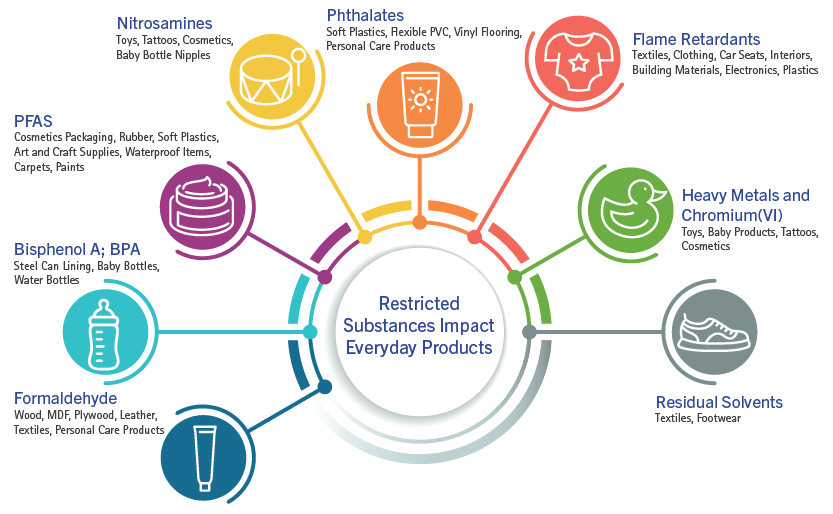
Restricted Substances Impact Everyday Products

Chemical Analysis for Restricted Substances

Solutions for Complex Restrictions

Compliance management for restricted substances is a dynamic and rapidly changing environment driven by regulatory agencies, retailers, and consumer demand. Manufacturers are challenged with ensuring their chemistries, materials, processes, and finished products meet demand and limit impact on health and the environment. Being prepared is critical.

Preemptive and Customized Testing

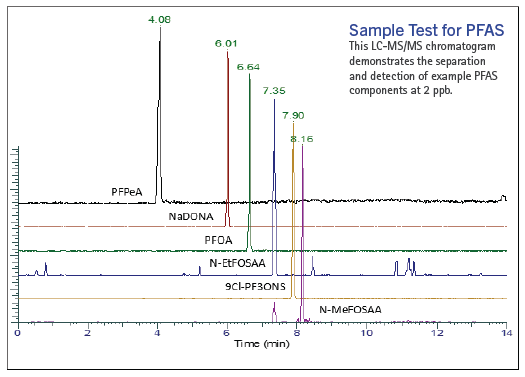
As the list of restricted substances grows, testing demands customized methods to identify issues early. This is a complex issue that requires a strategic approach and a technical team with extensive knowledge of chemical substance usage and testing plans. For example, some chemicals (e.g. PFAS) can be removed from manufacturing processes, while others (e.g phthalates) are ubiquitous.

Knowledgeable, Flexible Support

Eurofins EAG Laboratories supports clients with regulatory guidance, customized testing, and chemistry expertise. The team at EAG specializes in testing for representative compounds from restricted chemicals lists, such as the chemistries listed in the figure above.

EAG has validated methods for more than 200 specific chemicals that may be of regulatory or toxicological concern. These compounds are representative of those called out in legislation such as REACH, Prop 65, RoHS, CPSC, in addition to FDA, EPA, and MDR/EU directives.

EAG has developed partnerships with industrial consultants, who can offer expertise and recommendations to devise a client-specific risk management approach for their supply chain and product development. Together with these industry leaders, our team can propose a testing program that matches with our clients’ risk-management program and budgetary constraints.

Once results are obtained, we can offer further perspective of the ramifications of a particular result in lieu of the most recent regulatory directives. We interpret and effectively communicate the data for solutions that make a difference to our clients’ bottom line and business success.

Contact our team today for help with your testing needs.

More content you might like...

3D printed metal

Surface Analysis on 3D Printed Titanium

For 3D printed products, XPS can provide composition and bonding information for the top 5-10nm sample surfaces. Oftentimes, surface contamination/oxide thickness would affect the appearance (as well as performance when applicable) of the material, and XPS could help identify the source and/or cause.

Read More »
Doctor holding pacemaker

Effects of Stress on Medical Devices

Knowing the type of stress and how much there is in a small metal component in a medical device can be the determining factor on how well the device will perform, how long the device will last, or even whether or not the device is going to work at all.

Read More »

To enable certain features and improve your experience with us, this site stores cookies on your computer. Please click Continue to provide your authorization and permanently remove this message.

To find out more, please see our privacy policy.