Fingerprinting for Phase Identification

Fingerprinting isn’t just for people. It’s also a way to identify minerals.

I have a friend who has a collection of crystals. He walks into crystal shops all the time to admire the beautiful rocks and sculptures. Unfortunately, there have been some counterfeit minerals being sold at the price of the actual mineral. For example, authentic jade is a mineral called jadeite, but this mineral can be quite rare. Nephrite is a more common type of jade, but both can be counterfeited with more common minerals like serpentine, quartz, vesuvianite, and others. Sometimes fake crystals are even made by hardening resin in “crystal” shaped molds and dying the plastic different appealing colors. How can we spot counterfeit minerals? There are physical and visual clues known in the jewelry industry for spotting fakes, but what if there was a way to identify the material based on a unique fingerprint that couldn’t be faked?

What is phase identification for minerals?

Minerology was one of the earliest fields to benefit from X-ray Diffraction (XRD). Prior to XRD, minerals could only be identified by their external symmetry, shape, and color. XRD transformed mineral identification into an exact science, being perfect for characterizing crystalline materials by their internal structure, not just external appearance. XRD analysis provides an X-ray diffraction pattern where each peak in the pattern represents a different plane of 

jade jewelry

symmetry in the overall repeating structure. Once the data is collected, the peak positions are run against a comprehensive database of diffraction patterns. The number of entries in the database is the limiting factor to how successful fingerprinting can be. So, what databases are out there?

What is ICDD?

The International Center for Diffraction Data (ICDD) is a database with over a million data entries. The ICDD maintains the Powder Diffraction File™ (PDF®) which is the largest, most comprehensive database for diffraction patterns. Not all labs have access to this extensive database. There are several free databases online that can be used to search through XRD patterns (COD and AMCSD); however, these databases contain just over half the number of entries the ICDD database has combined. Eurofins EAG utilizes the power of ICDD’s PDF® to do phase identification.

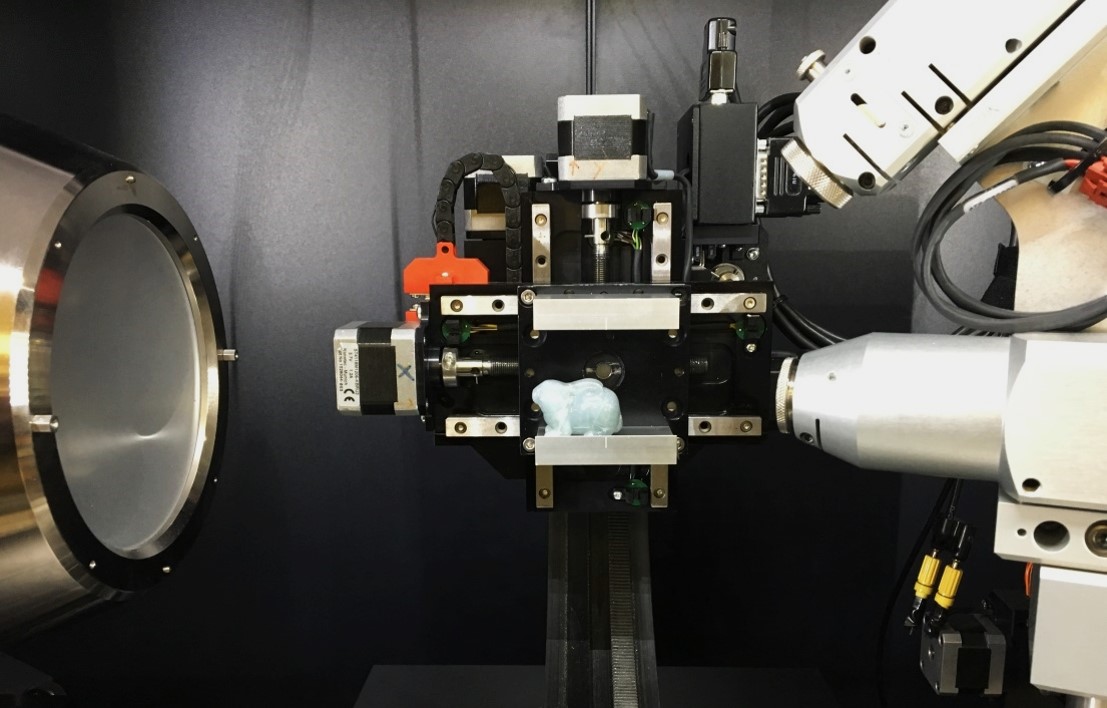
jade rabbit

How can Eurofins EAG help?

Eurofins EAG has a specialized XRD tool with a rare small spot size capability. This tool paired with JADE®, a software program integrated with the ICDD PDF® database, can easily determine phase identification for almost any type of mineral. Our XRD scientists have many years of experience with a wide range of materials and access to a network of labs and techniques. X-Ray Fluorescence (XRF) is the perfect complementary technique which provides elemental analysis to pinpoint exactly what elements are present in the material.

Contact us today to learn how we can help you with your next project.

More content you might like...

Ask the Expert: Silicon Carbide for HPE

Ask the Expert: Silicon Carbide for High Powered Electronics

February 12, 2025
During this live Ask the Expert event, we will answer pre-submitted questions from our audience regarding Silicon Carbide for High Powered Electronics. EAG Laboratories has a vast depth of experience analyzing silicon carbide using both bulk and spatially resolved analytic techniques and is the world-leading materials characterization and engineering resource for semiconductor testing.

Read More »

Product Reliability Testing Webinar

Wednesday, March 26, 2025
In this webinar, we will show you how Eurofins EAG supports you in the various phases of reliability testing to come to a robust product, including the different types of actual testing.

Read More »

To enable certain features and improve your experience with us, this site stores cookies on your computer. Please click Continue to provide your authorization and permanently remove this message.

To find out more, please see our privacy policy.