Eurofins EAG Expands Battery & Energy Storage Analysis with Electrochemical Impedance Spectroscopy (EIS)

Eurofins EAG Laboratories is pleased to announce the expansion of its electrochemical testing portfolio with the addition of Electrochemical Impedance Spectroscopy (EIS) capabilities, further strengthening support for battery, supercapacitor, and electrochemical energy storage development and failure analysis.

Electrochemical Impedance Spectroscopy is a non‑destructive, frequency‑domain technique that applies a small AC excitation to an electrochemical system and measures its response across a wide frequency range. By separating resistive and reactive (capacitive and inductive) components, EIS enables detailed insights into internal resistance, charge‑transfer kinetics, double‑layer behavior, diffusion processes, and degradation mechanisms.

Enabling Deeper Insight Across the Battery Lifecycle

EIS supports customers across R&D, qualification, and reliability programs by enabling:

  • Early detection of degradation and failure mechanisms, including increases in internal resistance and changes in interfacial behavior
  • Quantitative evaluation of charge‑transfer and diffusion processes impacting power capability and cycle life
  • Comparative analysis across state of charge (SOC) and temperature conditions to better understand real‑world performance
  • Correlation with physical and chemical failure analysis for comprehensive root‑cause investigations


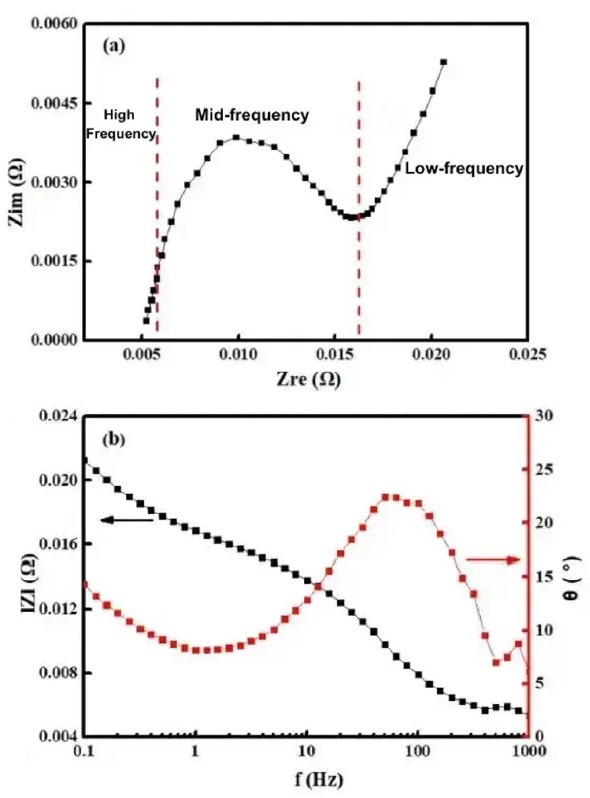
Results are typically presented using Nyquist and Bode plots, allowing engineers and scientists to identify characteristic time constants and performance‑limiting processes within complex electrochemical systems.

EIS Nyquist and Bode Plots
(above) Nyquist plot and (below) Bode plot.

Integrated with Eurofins EAG’s Materials & Failure Analysis Expertise

This new capability complements Eurofins EAG’s established strengths in battery failure analysis, materials characterization, and reliability testing. When integrated with techniques such as advanced microscopy, surface analysis, and chemical characterization, EIS helps connect electrochemical performance directly to material structure, interfaces, and processing conditions.

Contact us to learn more about Electrochemical Impedance Spectroscopy testing and how we can support you on your next project.

More content you might like...

To enable certain features and improve your experience with us, this site stores cookies on your computer. Please click Continue to provide your authorization and permanently remove this message.

To find out more, please see our privacy policy.