

Automated Test Equipment (ATE) Can Assist in the Automotive Industry
In sectors like the automotive industry, ATE plays a pivotal role in verifying the proper and reliable operation of critical systems.
Home » Incompatible Contaminant in Tubing
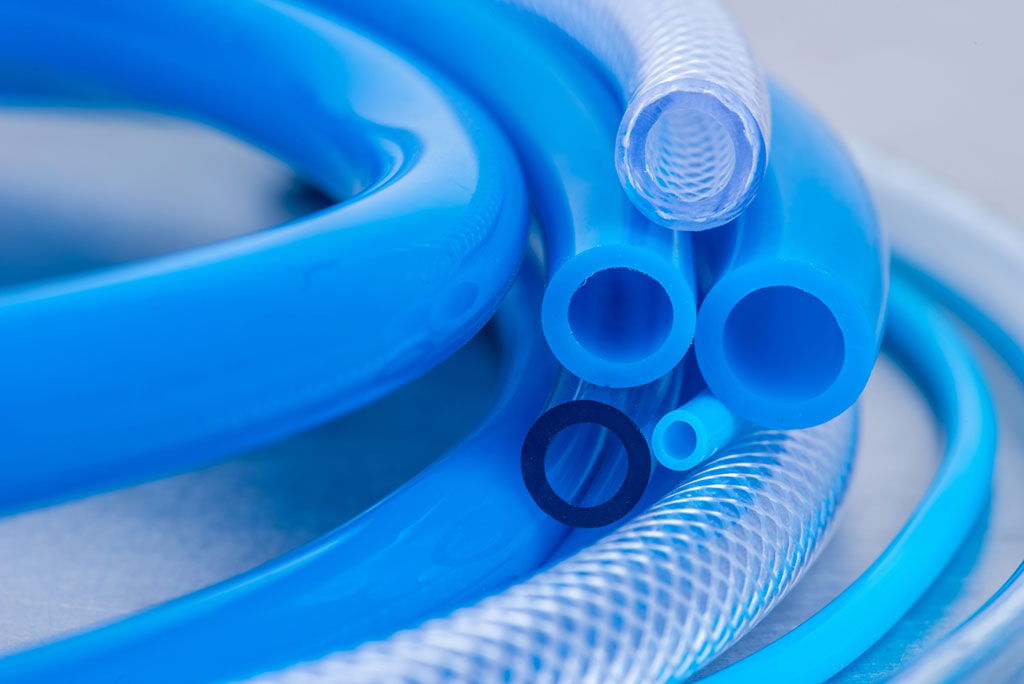
Highly durable, thermoplastic tubing works well in a variety of industrial applications and operating temperatures. This tubing can be resistant to many environmental conditions, as well as chemicals and oils.
A device manufacturer observed defects in a specific lot of thermoplastic tubing. The tubing exhibited signs of dimpling and axial deformation, suggesting chemical attack or exposure of the tubing to localized heating.
TGA was performed to compare weight loss profiles as a function of temperature.
The defect tubing had a significantly lower decomposition onset temperature compared to the control tubing. Additionally, the deformed tubing exhibited multiple weight loss steps compared to a single major weight loss step for the control. DSC profiles in the 1st heat scan (as-received thermal history), cooling scan, and 2nd heat scan (inherent properties) were also different.
Results indicate a compositional difference between the defect and control tubing materials, consistent with exposure of the defect tubing to an incompatible chemical.
For more than 50 years, scientists and engineers at Eurofins EAG have investigated and resolved product failures for clients. Our team of experts identify key failure indicators and follow them to the root cause.
Failure analysis of plastics, thermosets, and rubber materials is commonly performed on finished products and typically involve comparative analysis between failed and non-failed samples. Once the potential root cause is identified, experiments can be designed and conducted to test the hypothesis and recreate the failure in the laboratory. Eurofins EAG can evaluate a variety of polymer types, including:
Eurofins EAG Laboratories offers a full suite of analytical techniques to evaluate the identity, composition, morphology, topography, and rheology of polymeric materials and components.
Call +1 800-366-3867 or email us.

In sectors like the automotive industry, ATE plays a pivotal role in verifying the proper and reliable operation of critical systems.

Damage caused by ESD is one of the primary failure mechanisms for integrated circuits. Testing susceptibility to ESD events is crucial in the success of electronic devices and is essential for the qualification process.

For 3D printed products, XPS can provide composition and bonding information for the top 5-10nm sample surfaces. Oftentimes, surface contamination/oxide thickness would affect the appearance (as well as performance when applicable) of the material, and XPS could help identify the source and/or cause.
Uncover the invisible architecture of semiconductors with depth profiling using ion-TOF SIMS. This advanced technique reveals layer-by-layer composition in materials like silicon, GaN, and SiC. Learn how Eurofins EAG Laboratories supports your analysis with state-of-the-art tools and world class expertise.
To enable certain features and improve your experience with us, this site stores cookies on your computer. Please click Continue to provide your authorization and permanently remove this message.
To find out more, please see our privacy policy.